
Late one night, I received an email with an ominous subject heading:
“Lenny is about to bloom…and stink!”
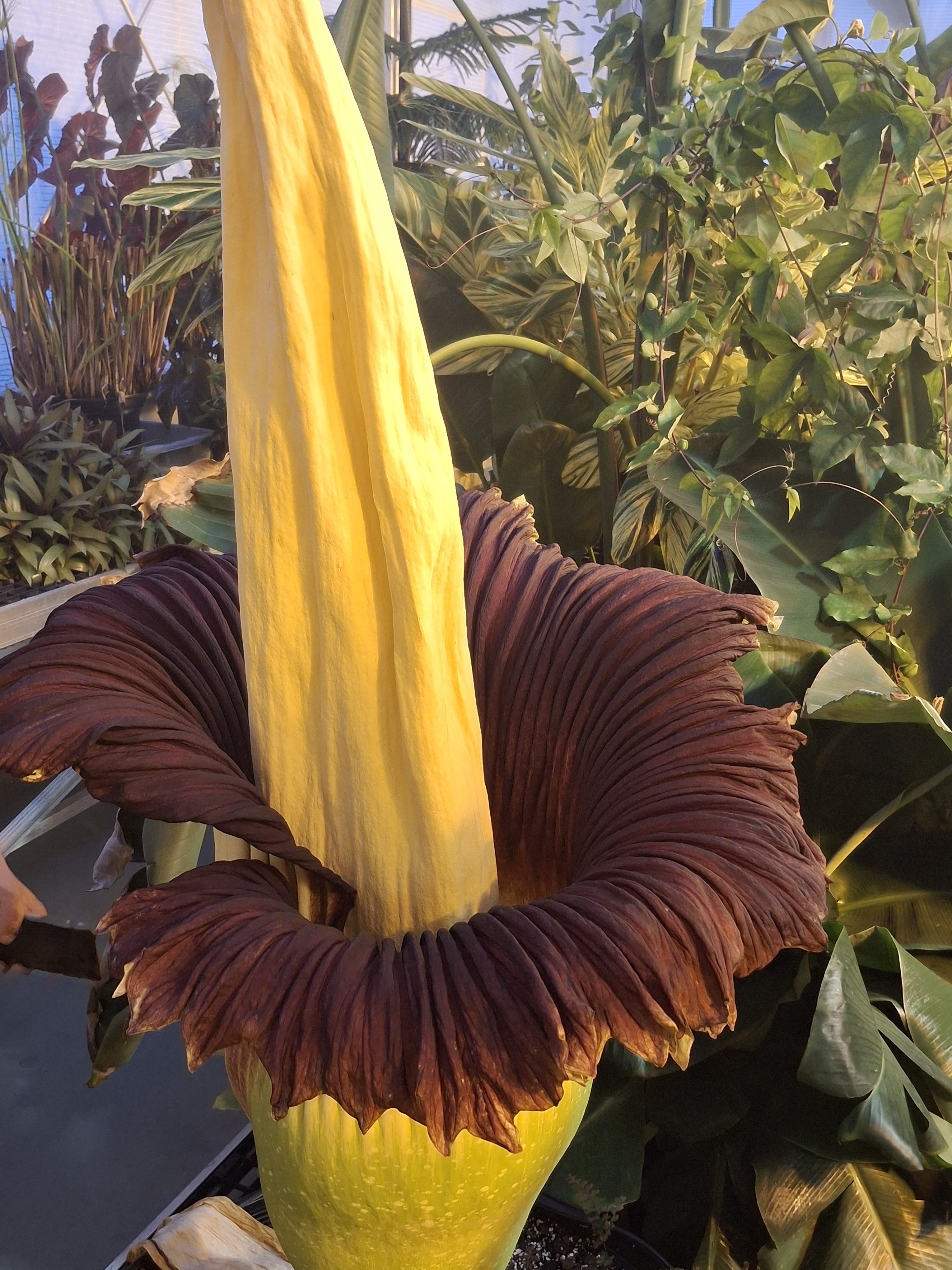
This was fortunately not about a person, but a plant; Lenny is one of the campus’s Amorphophallus titanum plants, known in the vernacular as the corpse flower. This flower–among the largest in the world–blooms every three to seven years, creating a single, gargantuan bloom (this time around, the inflorescence was around 55 inches tall.) When one of these flowers blooms, they emit both an alarming amount of heat (over a hundred degrees Fahrenheit) and, most famously, their nominal stench that has been described as “putrefying”, “nauseating”, and “corpse-like”, in order to attract various insects that feed on decaying flesh.
This was Lenny’s first time flowering; he is seven years old. Posters were hung around the biology wing of Singer Hall advertising him like a celebrity. Lenny is temperamental, they warned; he moves at his own pace, much like an aging rockstar or obstinate toddler.

Yeah, it smelled pretty bad.
We rarely encounter animals in the middle stages of decay, and when we do, we are almost always in a car–perhaps one of the more positive outcomes of our modern-day over-coddled life. We only smell death either when it has been there a long time (say, a mouse in a long-forgotten trap smelling of musk and time and diaphanous wings and disintegration) or a very short time (say, a bird brought home by a cat, smelling of iron and urine and freezer-burn and fear.)
Lenny smelled like something right in the throes of decay. He smelled like a woodchuck had been hit by a car, crawled into a pool of stagnant water, died, and then the water had dried up two days later, leaving behind a rotting corpse in a pile of mud, the smell heavy against the light air. The odor seemed to hang in haloes around the center of the flower.
It had bloomed in the morning, so most of the heat that accompanies a bloom had already dissipated, though I swore I could still feel a slight blanket of warmth around the center of the flower.
The flower’s look was no less bizarre than its smell. These plants are made of two main parts: the spadix, the structure that spires out from the center, and the spathe, the modified leaf that unfolds around the spadix to protect it. The suggestive shape of the spadix was what earned the plant its scientific name, Amorphophallus. Texturally, the entire plant seemed to be made of far thicker and stronger material than most plants. One friend remarked that it looked like someone had tried really hard to make a flower that looked like it was made out of paper. Streaks of lighter purple coloring ran down its darker purple spathe, while the spadix was bathed in a sickly yellow light.

Lenny certainly was having his moment of glory. Students and community members were there to admire him; children who were younger than Lenny himself were particularly excited at the prospect of the legendarily terrible smell. Of course, Lenny was not alone in the greenhouse; pitcher plants, orchids, and a host of succulents were there for audiences to enjoy once they had their noseful of the smell of rotting flesh.


Some of Lenny’s friends. I don’t know if they have names, so I’ve gone with Carl and Homer.
