
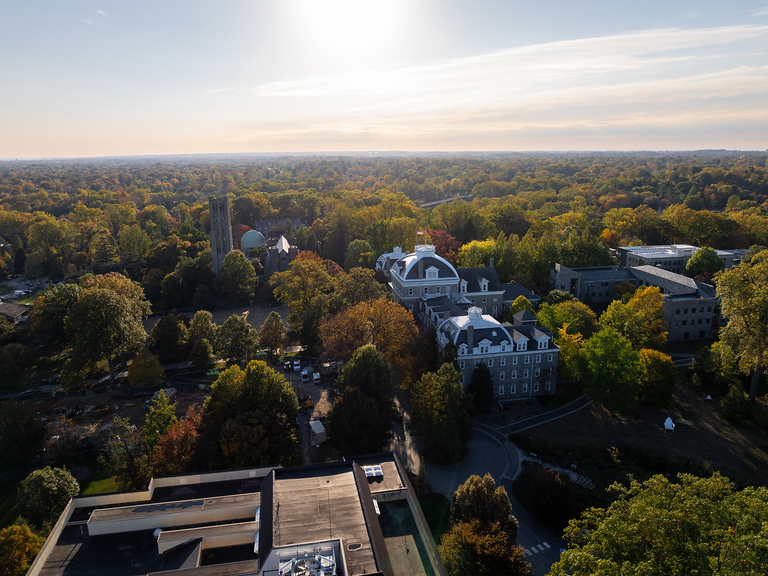
With just over 1,700 students spread across 425 acres, Swarthmore’s campus feels far larger than its modest enrollment suggests. New students quickly become familiar with the main centers of activity—Parrish Hall, the Science Center, McCabe Library, and the Dining and Community Commons—but the College harbors countless hidden spaces that escape notice. Over my time here, I’ve discovered many of these overlooked spaces and would like to share some of them. For some Swatties, these places have become central to their college experience; for others, they remain hidden by the Scott Arboretum’s lush vegetation or simply overshadowed by the semester’s demands.
1. Language Resource Center (LRC)
Located on the third floor of Kohlberg Hall, the Language Resource Center (LRC) escapes the eye of many students who do not major in Modern Languages at the College. As someone who wanted a semi-private study space with a scenic view and lots of natural light as well as space for me to ‘ponder pace’ and relax during breaks, I struggled to find a space at Swarthmore that matched these exact specifications until a friend introduced me to the LRC last semester. I was shocked! The perfect study space was sitting right above my nose in a building that I’ve had three classes in!! The LRC has an 180-degree view of the Northern end of campus, making for some spectacular views of the Science Center and Singer Hall while you study. Last final season, I spent countless hours in the LRC, made possible by its plentiful power outlets, luxurious armchairs, and proximity to Kohlberg Café (in case I needed a caffeine boost or a study snack).

2. The Makerspace
The MakerSpace is a vibrant on-campus space where you’ll encounter the same wonderful people again and again. Whether it is for an art student finishing their project for Sculpture I, or an engineering student building their boat for the Crum Regatta, the Makerspace has a range of tools, 3D Printers, fabrication equipment, woodworking machines, and even sewing devices available to all Swatties. I use it most often to maintain my bicycle, but last semester I also patched a hole in my jeans using their sewing machine. Friends have even constructed furniture for their dorm rooms in the space. Josh, the MakerSpace Manager, runs mandatory training sessions each semester for students before they can access the woodshop equipment. Despite these opportunities, the MakerSpace remains largely undiscovered, tucked away in Whittier Hall, the northernmost academic building on campus.

3. Crum Ruins
There’s a campus structure at Swarthmore which does not appear on any official map. Accsessed via the Smedley-Leiper Trail, a mysterious stone staircase emerges from surrounding forest, its weathered surfaces softened by moss and time. As you draw closer, a labyrinth of eroding walls and staircases materializes. This marks the start of the Crum Ruins which contains the Oak Knoll’s Italian Water Garden, an eerily serene place at Swarthmore, away from the hustle and bustle of campus life. Its remote location at the western edge of the Crum Woods has kept it hidden from most of the College community who dare not cross the Crum Creek. The ruins have a fascinating history, involving William Penn, local leaders, and the construction of the Blue Route (I-476).

Part of the joy of attending Swarthmore is exploring its sprawling campus and finding your own hidden spots. I encourage first-year students to wander into that building that you’ve never entered, climb staircases to floors you’ve never seen, and push open those doors that always seem closed. Not only will you discover secret corners of campus, but you’ll make this place truly your own. Stay tuned for Part 2!
