
If you ever had an inkling of interest for music, Swarthmore offers multiple opportunities to get involved.
This can range from student-led initiatives such as a cappella groups and student bands, to taking classes in the music department or joining any of the music ensembles for credit. Additionally, we have clubs dedicated to performing or discussing music.
In my freshman year, I participated in the Swarthmore Production and Music (SPAM) club, where we held bi-weekly jam sessions and worked on producing music with other students. It was my first time attempting to create melodies in my head and translating them onto sheet music ,and honestly… I was pretty bad at it.
But because of that club, I met the most supportive upperclassmen in a time when I was still adjusting to Swarthmore and felt encouraged to keep pursuing my interest in music. Perhaps, I wasn’t the best at song-writing or producing songs but there were other avenues to explore regarding music at Swarthmore.
Thus, I joined the Garnet Singers, an audition-based choir of about 30 singers. I grew up singing in choirs and knew I wanted to continue that in college so it made sense to join. I remember practicing for my audition, repeating the same 30-second section of “Vienna” by Billy Joel and ensuring I was conveying the right emotions and hitting the right notes. For me, what made a choir special, compared to solo work, was the process of receiving a particularly challenging piece and slowly improving on it as a team until it’s perfect.
Now as a senior, each performance and rehearsal is bittersweet, but as a last hurrah, Garnet Singers is going to the U.K as part of an embedded study trip! This is not unique to the choir—the Gamelan Semara Santi ensemble, a classic Indonesian percussion orchestra, recently traveled to Bali to perform there too.
Outside of ensembles, you can also take classes offered by the music department. In my sophomore year, I took a “Music and Math” class which took an interdisciplinary approach to music theory. While extremely interesting, my favorite class I took in the department was “Introduction to Music Technology.”
Essentially, this class is about learning how to use a MIDI keyboard (a keyboard that translates physical input to a digital signal for music software programs) and creating short electronic music pieces. I spent way too much time working on my music projects, but I learned about the process of producing music in a different way than what I did in SPAM. The class included listening sessions where each person presented a piece based on specific guidelines and musical process behind it. It was incredible to hear how everyone could interpret the same assignment so differently and yet make such cool music. The class served as a reminder that the definition of music and how a person interacts with it can widely vary.
Even if a Swattie never takes a music class, never joins an ensemble, or never joins any music interest clubs, they still can interact with music.
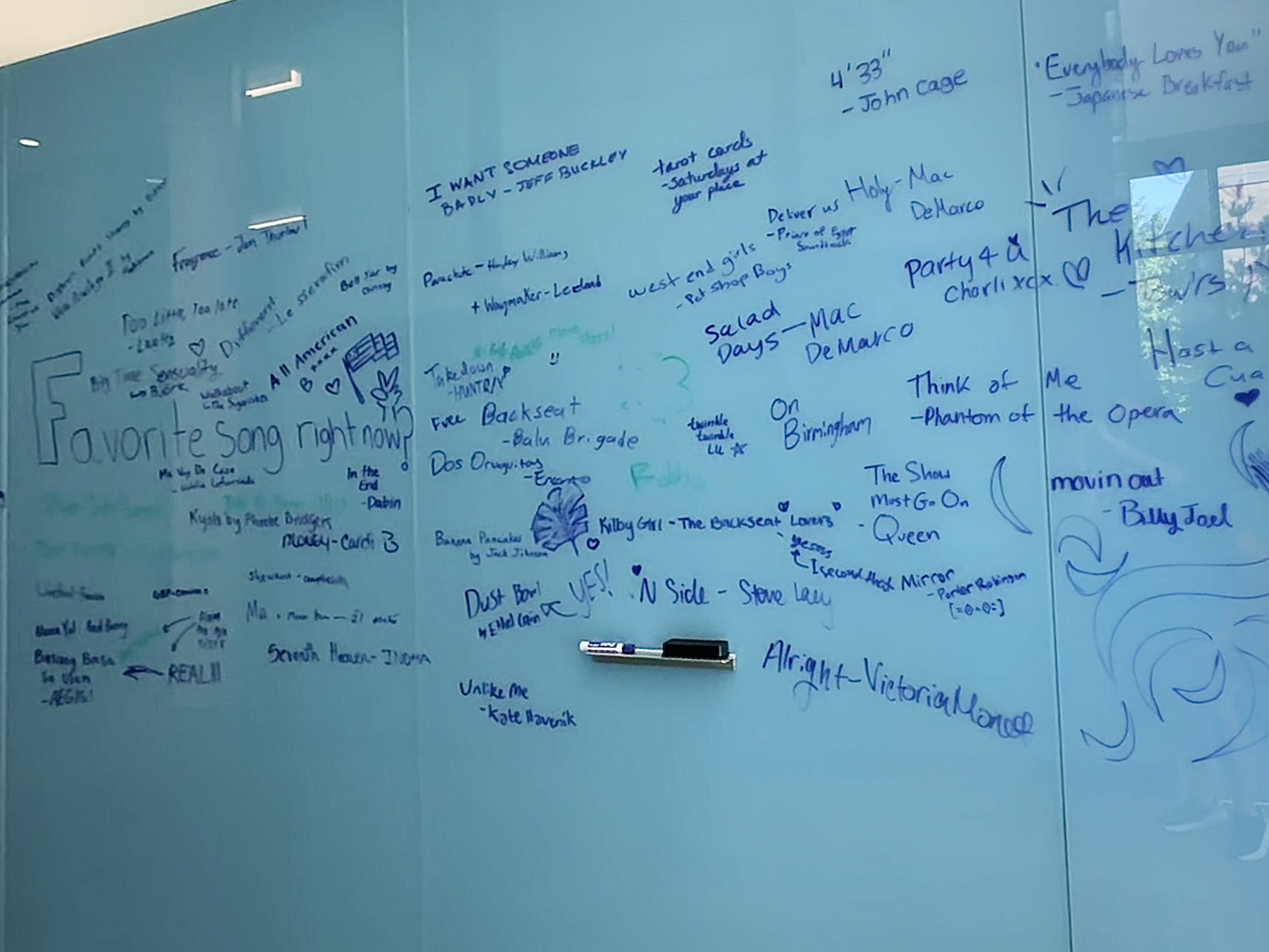
I’ve always believed that music is a universal language and well… everyone’s got a favorite song right?
So I wrote across a huge whiteboard “What’s your favorite song?” for the people walking through Singer Hall, an academic building.
I received many responses from all different music genres, artists, and languages.
And though I never knew who wrote what, it stands as an example that Swatties are connected through music in some way or shape.
