
Over the past year, my engagement with Swarthmore College’s Japanese Department has been both emotionally and intellectually wonderful. In fact, despite having taken Japanese for all four years of high school, I feel I learned more in the past semester and a half than in that entire span. The course’s pace is notably quick. In fact, we have already completed the Nakama 1 textbook (487 pages) and are making our way, currently through Nakama 2. However, I truly feel that the department’s approach to education allows all students, regardless of experience, to thrive.
For those who begin college with a more advanced understanding of the language, there is a placement test that places students in the class that best aligns with their prior educational background. In high school, my Japanese courses relied primarily on vocabulary and sentence memorization, rather than grammar, so I was rightly placed in Japanese 001. The course meets five days a week–twice for lectures, where we dive into grammar, linguistics, vocabulary, origin, and practice with English assistance from the professor, and three days of lab, which is conducted entirely in Japanese. Between courses, there were typically about 3-4 workbook pages to complete. Through this consistency, however, the fruits of my labors began manifesting nearly immediately. I was able to not only operate through an understanding of words, but also with a learned ability of how to formulate and express my own thoughts and ideas–properly filling in gaps with vocabulary through equally understandable expressions.
I was once told the following: at Swarthmore, First-Year Japanese should provide you with the knowledge to travel to Japan on your own without a hassle, Second-Year should be enough for you to live in Japan for a short period of time, Third-Year would allow you to live there for quite a while, and Fourth-Year should allow you to work there long-term. Observing both my own progress, along with the knowledge of my friends in these other courses, I believe that this projected progression is, indeed, highly achievable.


First semester final review, slides from snow-day lab section, and worksheet from early second semester.
The department also works to host as many language and cultural opportunities as possible. Each week, they have a chat hour and a language table. Chat hours, which take place on Sunday evenings, bring together students of different levels to have conversations in Japanese, allowing for practice without professors present. Language tables occur on Wednesdays during lunchtime and are attended by both students and professors, serving as an opportunity for conversational practice at varying levels and presenting a casual setting for language development. These events are often themed, too, so there are usually opportunities to celebrate different Japanese holidays (like getting to throw beans at your professors [dressed up as Onis] during Setsubun) and make things like onigiri, mochi, and origami. Additionally, there are Nakama Tutoring sessions every week, where students can get one-on-one help from native or near-fluent speakers. Finally, there are VLTs, or Virtual Language Tables, where students collaborate with university students and faculty in Japan via Zoom.


Setsubun trivia and Origami folding with Yoshimura-Sensei & my friend.
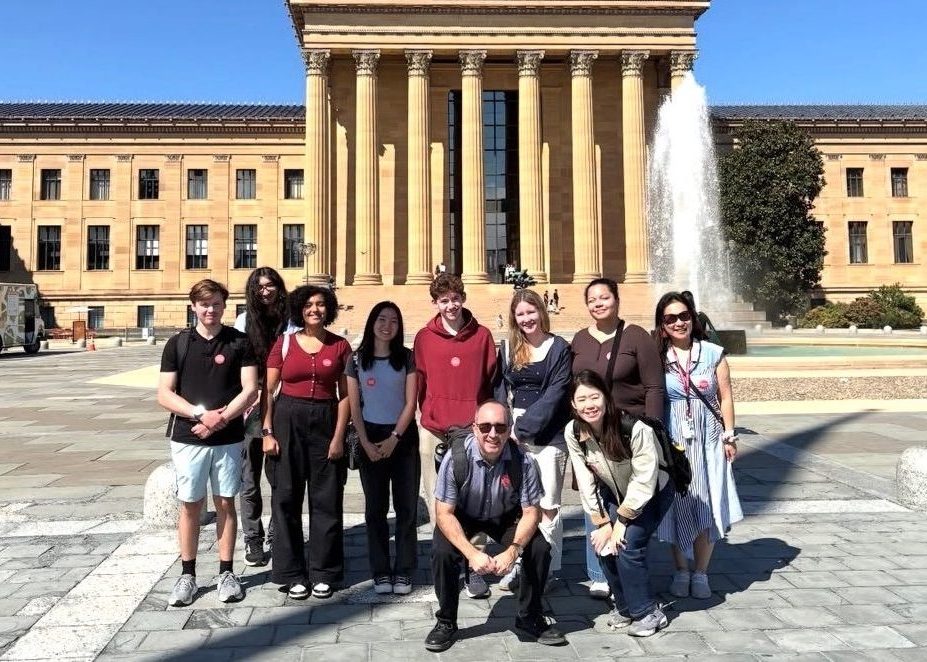
In terms of cultural advancement, the department often hosts events both on and off campus. During my first semester of Japanese (Fall, 2025), we attended a field trip to the Philadelphia Museum of Art and got a private, behind-the-scenes tour of their Ceremonial Teahouse room. We also had a Curry Party at the end of the semester, where they served homemade curry, and the different classes competed in a karaoke competition (yours truly snagged the victory for that one :)). This past semester, they hosted a traditional martial arts workshop with a Japanese sword master, comprised of a lecture, demonstration, and interactive portion where everyone practiced different pre-Meiji Restoration self-defense techniques and worked with weaponry like bo staffs and short staffs.


Photos from Philadelphia Museum of Art Field Trip, eating katsu sandwiches, and the sword master’s martial arts demonstration.
Since I began this blog, we also celebrated the arrival of springtime with a visit to the Shofuso in Philadelphia: a 17th-century-style Japanese house and garden built originally in Nagoya in 1953, built using traditional techniques and materials. Here, we learned about various elements of architectural history, had a picnic under the cherry blossom trees, and took in the stunning beauty of the garden.


Various photos taken during our trip to the Shofuso (4/4/26)
Notably, I am also enrolled in Japanese 073: Transnational Japanese Literature, which discusses the diversity and diaspora in modern Japanese literature. This course focuses predominantly on challenging myths of Japanese ethnic homogeneity and cultural isolation. Thus far, we have examined the works of Japanese writers writing from abroad, colonial and postcolonial literatures, migration and writing in the Japanese diaspora, and the writings of ethnic minorities in Japan, including writers from Okinawa and Japan’s resident Korean community. This course brought Marina Nascimento, a PhD candidate, to give a talk on “Shared Temporalities of Girlhood in Imperial Japanese Literature.” Additionally, we recently had a film screening of Ainu Mosir, a work dealing with the representation of Japan’s indigenous Ainu population.
I have found myself, in many ways, pleased by the Japanese department and the opportunities that it has to offer. Most significantly, I have advanced my language skills and cultural knowledge tremendously. Alongside this, though, I have had the ability to engage with a brilliant set of faculty and with many incredible fellow students of different backgrounds and levels. Thus, as I prepare for my upcoming summer abroad program in Nagoya, Japan, I find myself infinitely more appreciative of the skills that I have learned, and will continue to learn, through this department.

Photo from our Curry Party karaoke performance, singing Kazuo Funaki’s “Koukou Sannensei.”
