
“Hey Xinyun, how’s the architecture drawing class? What buildings are you drawing?”
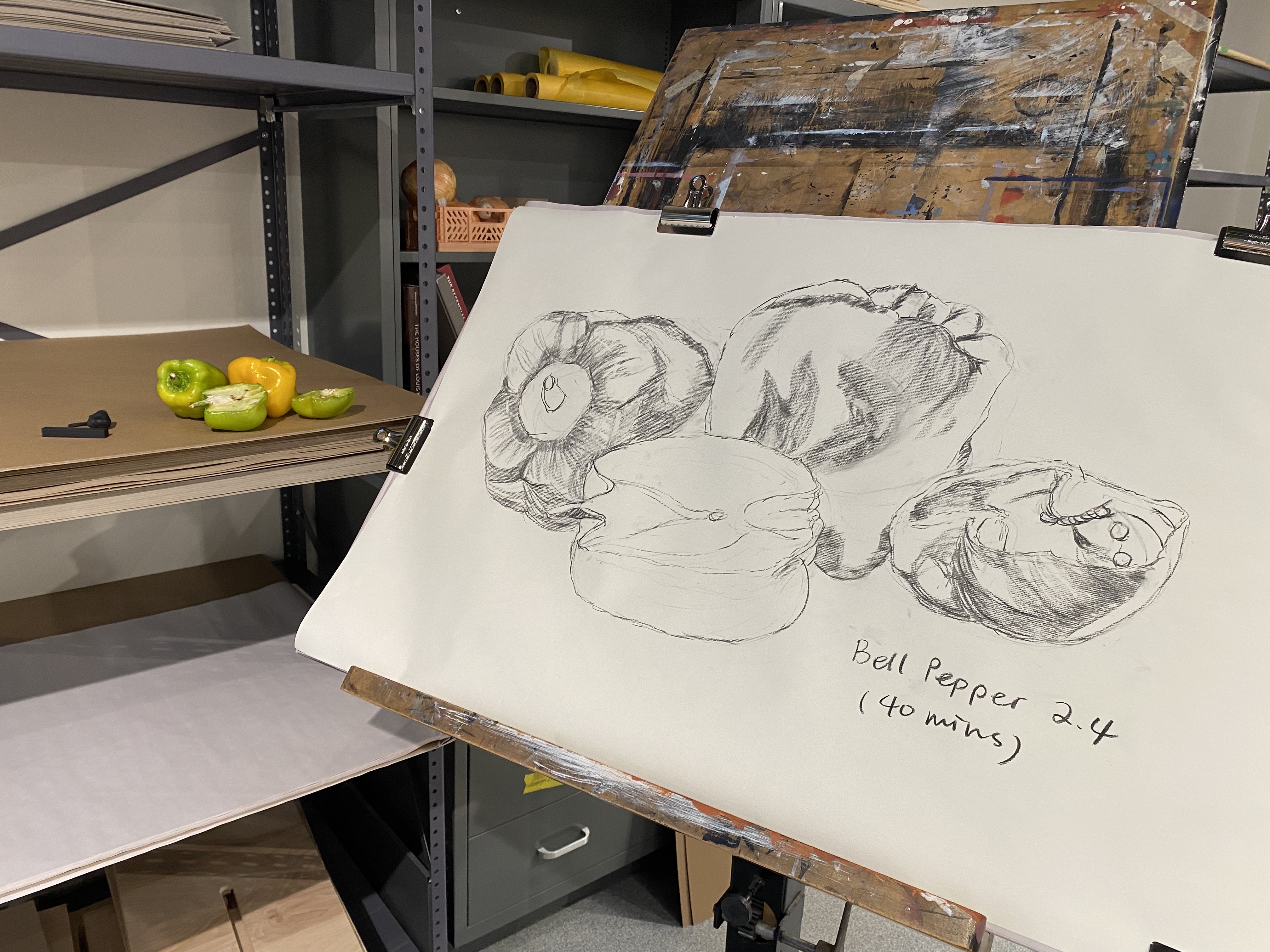
“We are not drawing buildings actually. Interestingly, we drew ginger, onion, and some other random fruits and vegetables in our first class. I got zucchini! I don’t think we are going to draw any type of buildings in this class, according to the syllabus. This week’s homework is drawing garlic.”
This conversation happened many times between me and my friend at the start of my sophomore fall semester when I took Experiments in Drawing, an architectural drawing class. I didn’t quite know how to best explain what we did and what I learned from the class—an architecture drawing class without drawing architecture. A few weeks into the semester, the class became one of my favorite courses, if not the favorite. This was how I explained it to friends after developing a sense of what the class was about: “We are not drawing architecture but learning to draw like an architect. You don’t necessarily need to draw buildings to learn that. Garlic, bell peppers, paper bags, shoes, and random messes—they all work!”
Experiments in Drawing, offered by Prof. Sony Devabhaktuni, is a course in our newly established architectural studies program under the art department. Like most architectural studies courses offered at Swarthmore, students don’t need prior experience to join the class. The goal of the program is not to train professional architects, though it does serve as a good preparation for students hoping to get into professional schools. It welcomes all students to experience thinking like an architect—through reading, writing and talking, as well as drawing and looking.
I decided to take Experiments in Drawing after finishing my first architecture class. Of the many things I learned from the class—the various ways architects shape our physical environment, as well as social realities—I realized that drawing is perhaps the most indispensable skill for architects. So, very naturally, I went on to take a class that focused on drawing. We were a class of eight students and met for two three-hour sessions each week. Every Thursday, we had a figure drawing practice session together. On Tuesday, we brought our drawing homework to the class, turning the studio into a seminar where we talked about drawings and readings.
Our reading assignments were selected from a wide range of disciplines, which truly excited me! We read about how architects and sculptors write about drawing, how anthropologist interprets mark-making, and how musician speaks about grasping one’s imaginative thoughts. Experiments in Drawing exemplifies how studio and performing arts are taught at Swarthmore—the practice of technical skills and the exploration of ideas behind artmaking happen alongside each other. It extended my understanding of drawing: more than a technique, it manifests the human action of seeing with attention; it is a way of experiencing space, and fundamentally, a way of attending to the world around us, the mundane and the extraordinary. My learning in that class culminated in a three-week drawing of the chairs on campus—a topic I chose for myself. From the cozy armchairs in Trotter atrium, to the big chair on Parrish beach, I saw and drew chairs as objects having unique personalities.
With no training in drawing before taking the class, I experienced some of the steepest learning curve I had ever had. It introduced to me drawing, or you may call it the fusion of eyes, hands, and the mind, as a way of thinking. The best classes always give me new lenses through which to think and to continue learning on my own even after the class ends. With pen and paper, drawing can take place anywhere, at any time.
