
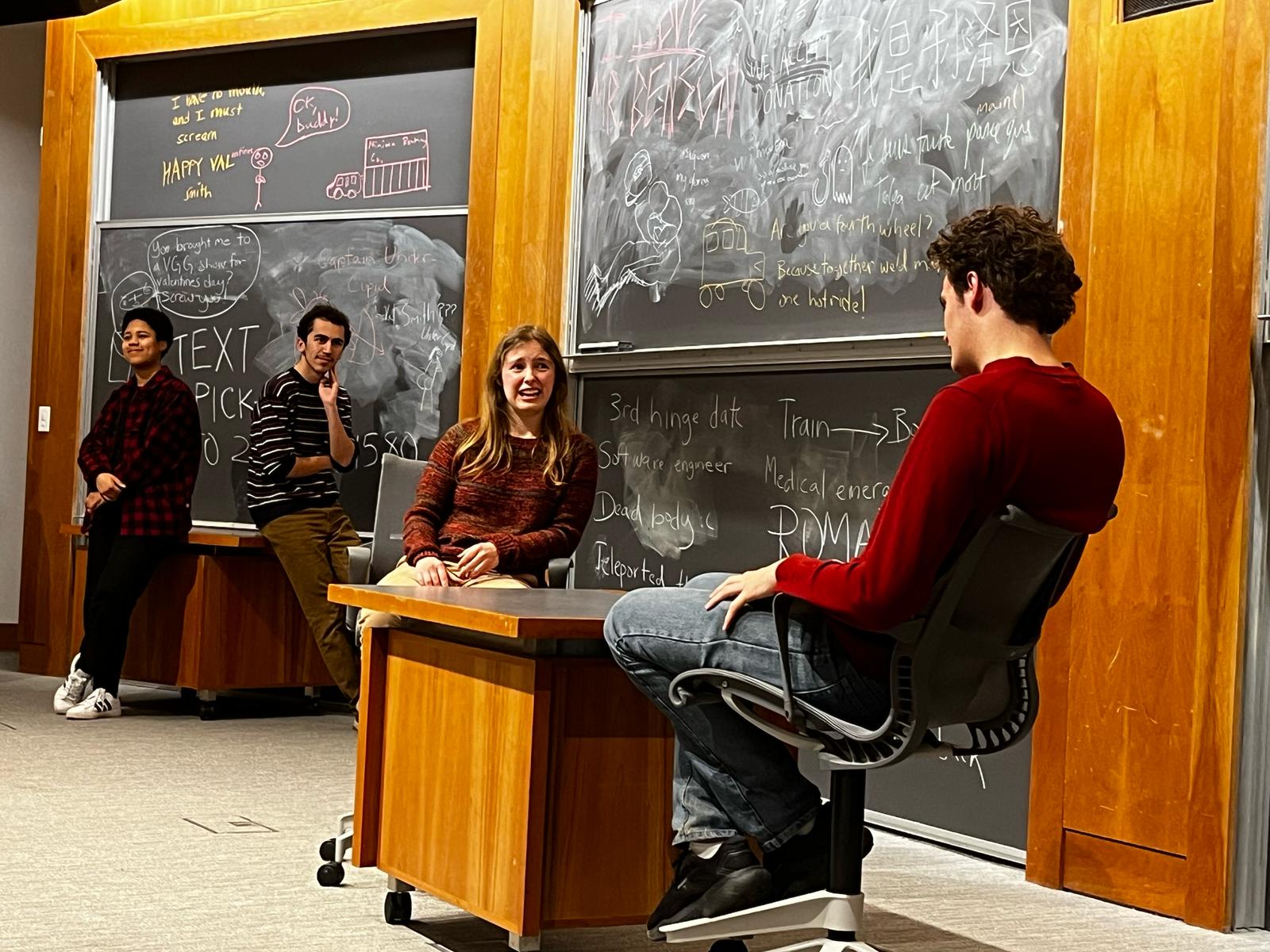
When I first came to Swarthmore, after orientation week, there were posters hanging around advertising an improv show by a mysterious student group called “Vertigo-go,” a name I thought sounded rather silly. Improv is a form of comedy with a very simple premise; all scenes, jokes, and characters are made up on the spot, and typically based on audience suggestions of some kind. Though I had some familiarity with improv (having been a theater kid in my youth) I had never attended an entirely improvised show; I had only experienced it as a warmup or diversion to more scripted acting. I didn’t quite know what to expect. What would a room full of amateur comedians making things up on the spot really be like?
Torrential thunderstorms meant that the group had resorted to an rain location in a rather small classroom; it was among the most crowded rooms I’ve been in here, besides when Angela Davis came to talk. But the eight performers quickly made me forget about any discomfort relating to my seating position.
The show was structured as a series of games, and each game had a twist that helped dictate the direction the scene went in (talking to people later, they feel, and I agree, that having these “games” helps to structure the show more than just an hour of freeform improv; it gives the audience and the performers some variety.) Some of these games included a scene with a single “character” made up of two people who had to say everything in unison (and so talked with a strange, slow speech, and ended up saying things that neither of them would have ever thought about), a scene with only two people who had to play more than two characters (in order to differentiate them, the performers were forced to resort to terrible accents and bizarre ways of walking), a scene with two people on stage both being voiced by people offstage (essentially making them into living puppets), and so on.
The thematic material of every game was taken from the audience, who were asked for suggestions of any kind–no topic too odd. I have many negative feelings about audience participation in the performing arts (both when I’m performing and when I’m an audience member) but even my jaded soul will concede that audiences often scream out rather creative ideas (and, just as often, ideas that are completely infeasible for any number of reasons). This kind of participation is an easy way to make people invested; I myself was shouting miscellaneous suggestions at the cast whenever they asked if I wasn’t in stitches myself.
At the end of the show, the group announced that they were looking for new members. As I walked out, I was determined that I was going to audition for the group.
And so I did.
And I was not even asked back for callbacks.
Of course, I was sent the typical, very kind rejection email–there were so many talented people, if we could, we would offer everyone a spot, and so on–but I still felt very disappointed. And I went to all of their shows and laughed, but always felt a little bit sad that I couldn’t be up there.
So I decided to do something unusual for myself: I took advantage of the ending line of the rejection email, the classic “we encourage you to audition again next year.” I decided to try again, as the old adage so often urges you to.
And I did.
And I was asked to callbacks.
And I went back.
And I got in.
And I was very happy.

I think my success had to do with being more of a “team player,” in a sense; making jokes is very easy. Making comedy is perhaps harder. An improv scene where both people are simply trying to be as funny as possible in the moment will fail to build a satisfying overall narrative, and will more likely than not end up feeling like a series of disjointed, exhale-through-your-nose-but-not-your-mouth moments. Your job in an audition like this is not just to show that you can make appropriately-timed jokes and witty banter; it’s to show that you have the ability to give others the opportunity to as well.
It has been an amazing experience to be in Vertigo-go. I feel like this kind of performance is good for my music–it lets me give it an air of theatricality that just makes it fun to watch–but even more, it’s good for the soul. It is great to come into practice after a long day and be able to laugh with some very talented people who I am lucky enough to call troupemates (and, perhaps, friends.)

We have many things in store for our future, both immediate and long-term. Our next Vertigo-go show is during reading week (the week we have off after classes end and before finals) and it has to be done outside, as we are playing several games involving water. We will also give the audience water guns and balloons, which they are free to use at their discretion. We are also building connections with other student groups at Bryn Mawr and Haverford, and even have plans for a (still very hypothetical, but exciting nonetheless) Tri-Co comedy festival sometime next year.
But hey, we’re an improv group. We don’t even know the futures of our own shows. We just Vertigo-go with the flow.
