
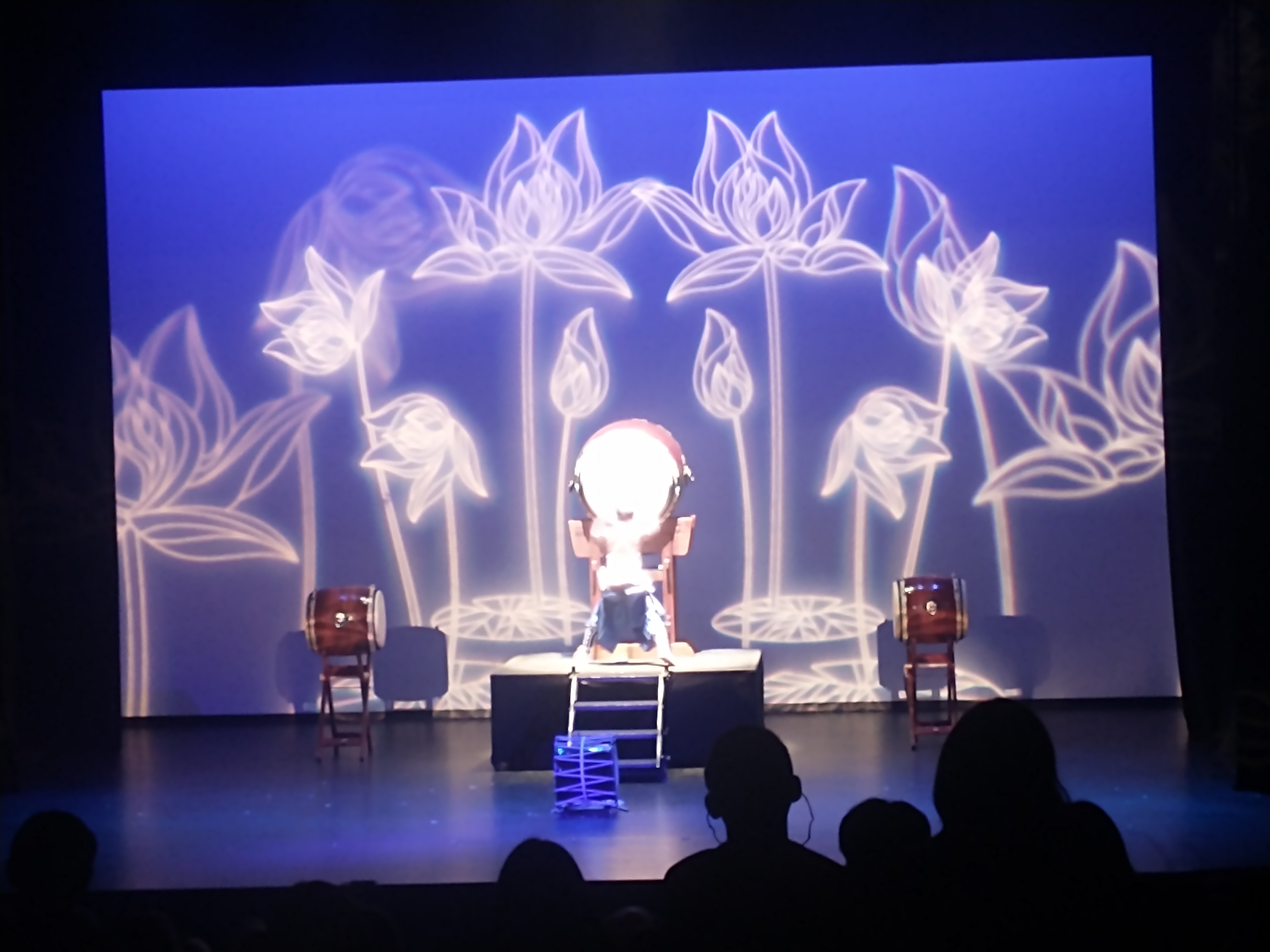
The Taiko concert this fall was the most crowded I had ever seen the auditorium. I arrived almost half an hour early, and still had trouble finding a row of seats for me and my friends. On the stage was a massive assortment of drums, and as the lights dimmed, over seventy musicians from more than a dozen groups took the stage to play, and so began one of the best concerts I’ve ever been to.
Taiko are any one of a number of different Japanese drums, and a taiko ensemble is a group of musicians playing said drums. There are many different types of drums, all varying in pitch, timbre, and volume. Eitetsu Hayashi, now over 70, is a world-renowned taiko player who became famous for his stylistic dynamism and immaculate technique. Hayashi was in residency at Swarthmore College for a week, giving talks, lectures, and workshops to our taiko ensemble. “The week of Eitetsu Hayashi’s residency–affectionately known as “Big Week”– was one of the most eventful weeks of my college experience. My taiko friends and I have been looking forward to Big Week since last semester when we found out about it,” said Sho Glashausser, a member of Swarthmore’s ensemble.
“Working with Eitetsu Hayashi was both enlightening and exhilarating,” he said. “ I was somewhat intimidated about meeting such a revered figure. However, he has a good sense of humor, and his jokes and playful comments made me feel at ease in his presence.”
“My favorite memory with Eitetsu Hayashi is chatting with him after one of the evening talks. It was my first time meeting him and I was nervous, but I garnered the courage to ask him a question in Japanese. My Japanese is far from perfect, but he was very accommodating. After he answered my initial question about his taiko style, we discussed some other topics like speaking Japanese in America and college life. I am lucky to have had this chance to connect with him.”

His week culminated in Sonic Bodies, a multi-hour concert featuring Hayashi and his small five-person ensemble. The first piece, Sen no Kaikyo (One Thousand Echoes of the Sea) was a piece composed by Hayashi (in fact, all but one piece was composed by Hayashi, and the one that he did not compose was written for and arranged by him.)
This was a piece with seventy-two musicians, and it is among the most impressive single pieces of music I have had the pleasure of witnessing, just in terms of scale. Written for a thousand taiko drummers to commemorate the fifth year of reconstruction after the 1995 Kobe Earthquake, it was astounding even with only a fifteenth of the number. Taiko ensembles from Columbia, Cornell, and Wellesley all joined Hayashi on the stage, in addition to the Swarthmore ensemble and many community members.
Afterwards, Hayashi and his ensemble (five people in all) stayed on stage to play their repertoire. These ranged solo pieces for Hayashi and a small Buddhist fan drum to a gargantuan piece for seven of the largest type of taiko drum, the o-daiko, made out of old-growth trees, a booming body as large as the player. After intermission, we were treated to one of Hayashi’s innovations, his stage-theater works. Mio no Hasu (A Lotus on the Water Channel) is a six-movement work focusing on the life of a Japanese forestry engineer during the 1914 occupation of Korea. It was a marathon of a piece, Hayashi never once faltering or missing a beat.
Afterwards, the standing ovations went on for what felt like hours. Every second was deserved.

Many thanks to Sho Glashausser for consulting on this article.
